

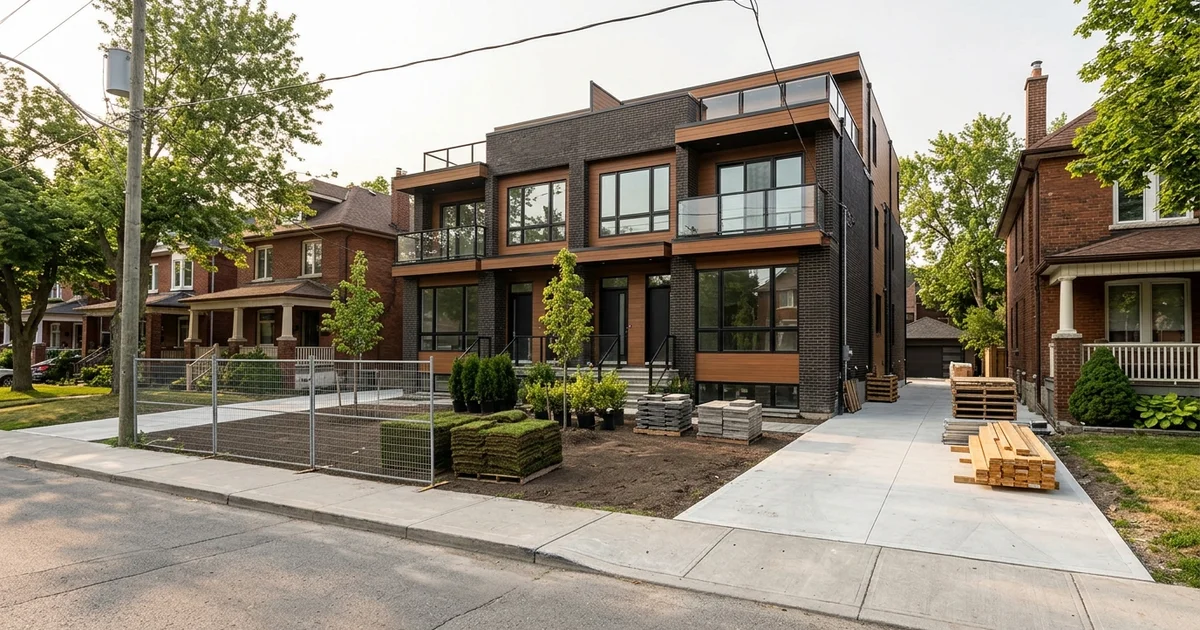
Fees That Arrive at Permit Stage
From what we see in the field, construction costs hog the spotlight, but government fees at the permit stage actually dictate a project’s early cash flow.
These soft costs can easily run into the tens of thousands of dollars before a shovel ever hits the dirt. Detailed planning prevents budget shortfalls later on.
Our building permits service includes an itemized fee estimate to remove this guesswork.
This guide breaks down exactly what to expect and how to calculate these numbers accurately. Proper preparation saves you from costly delays.
Rule of thumb
Verify current rates at the time you budget, and again when you apply. Fee schedules and exemptions have changed several times in recent years.
Building Permit Fees
Toronto calculates building permit fees based on the type of construction and total floor area. A multiplex naturally incurs higher costs than a single-family home due to the expanded footprint and multiple dwelling units.
We suggest clients use the 2026 fee schedule as a baseline for their pro forma. For example, interior renovations currently sit at $11.53 per square metre. You must also account for the $56.33 flat fee added for each newly created residential unit.
Our team always factors in the steeper rates for new construction, which currently sit at $18.56 per square metre. These baseline charges do not include extra hourly fees for zoning reviews or revision processing. Every municipality updates these figures annually.
Key permit cost factors include:
- Total floor area of the multiplex
- Type of construction (new build versus renovation)
- Number of newly created residential units
Development Charges
Development charges exist to fund essential city infrastructure like public transit, road expansions, and parks. Historically, every new unit triggered these steep fees, making multiplex projects financially difficult.
We watched the landscape shift dramatically when provincial legislation, specifically Bill 23 in 2022, waived these charges for the second and third units on most residential lots. Toronto went even further in July 2025 by passing By-law 654-2025. This landmark decision completely eliminates City development charges and parkland fees for up to six units on a single lot.
Important Exemption Note: The six-unit exemption easily saves property owners anywhere from $40,000 to over $100,000 upfront in Toronto.
Our financial models show this exemption fundamentally changes the viability of missing-middle housing. You must verify your project’s specific eligibility before banking on these savings. The exemption depends on factors like the conversion type, unit configuration, and the precise timing of your application. Our guide on how long a multiplex building permit takes in Toronto shows where that timing falls in the approval sequence.
Other Fees to Budget
Upgrading a multiplex often triggers a cascade of smaller municipal and utility fees. A standard half-inch water line simply cannot supply adequate pressure for four or six separate apartments.
We typically see clients needing to upsize to a 1-inch copper line to meet building code requirements. This water service upgrade from the city water main to the property line costs approximately $5,875 for a 1-inch connection in 2026. Trenchless pull-through excavation can add 40% to the upfront cost, but it saves thousands in driveway restoration.
Our designers also account for Toronto Hydro upgrade fees, which vary wildly based on the required service size.
| Fee | When | Notes |
|---|---|---|
| Building permit fee | At permit issue | Based on floor area and building class |
| Development charges | At permit issue, if applicable | Many additional units exempt; verify |
| Committee of Adjustment fee | At variance application | Only if a variance is needed |
| Water and sewer connection | During construction | Toronto Water, $5,875 for 1-inch line in 2026 |
| Hydro service upgrade | During construction | Toronto Hydro, varies with service size |
| Right-of-way permit | Before road cuts | For work in the public road allowance |
| Tree permit | If trees are affected | Urban Forestry |
| Parkland and education charges | If applicable | Check current 2026 rules |
Modelling Fees in Your Pro Forma
Building an accurate financial model requires isolating these government fees from your hard construction costs. Tracking these soft costs separately ensures you have enough liquid capital available right at the permit stage.
We recommend structuring your pro forma to accommodate sudden rate hikes or unexpected zoning reviews.
- List every fee in a separate soft-cost section of your budget
- Use current 2026 rates, not last year’s
- Add a contingency for fee changes between budgeting and application
- Note which fees are timing-sensitive, such as those tied to the permit application date
- Revisit at permit stage, when exact amounts become known
Pushing a project to five or six units opens access to the CMHC MLI Select program. This financing vehicle allows up to 95% financing and 50-year amortizations, which drastically alters long-term profitability.
Our guide on multiplex construction cost shows how soft costs fit around construction for the bigger budget picture.
Outside Toronto
Every municipality across the Greater Toronto Area enforces a unique fee structure for multi-unit housing. Expanding beyond Toronto proper means working through a complex web of regional and local development charges.
We always remind investors that York, Peel, and Durham regions stack their own regional fees on top of the local city charges. For example, building a fourplex in Mississauga requires checking their specific 2026 interior alteration rate, which is $6.84 per square metre. Budget these regional layers separately for projects outside the city to avoid massive mid-project shortfalls.
Regional development charge districts include:
- Peel Region (Mississauga, Brampton, Caledon)
- York Region (Vaughan, Markham, Richmond Hill)
- Durham Region (Pickering, Ajax, Whitby)
Scarborough Example
Analyzing specific neighborhoods highlights exactly how zoning dictates your final fee schedule. For Scarborough multiplex costs, the regulatory landscape changes dramatically depending on your exact postal code.
We see a massive difference between building a standard fourplex in south Scarborough versus a sixplex in Ward 23 North. As of the June 2025 by-law updates, Ward 23 is one of only nine districts in Toronto that permits six-unit buildings as-of-right. Pushing a project to a Part 3 sixplex triggers larger floor area fees and mandates a much larger water service connection.
Our project managers suggest estimating these compounding costs with a structural engineer before committing to the extra units. These larger configurations demand entirely different utility capacities. Checking these requirements early saves you from tearing up newly poured concrete later.
A Fee Budgeting Worksheet
Use this interactive worksheet to organize every potential permit fee for your upcoming project. Gathering quotes from the City and utility providers early prevents major budget blowouts later.
We strongly suggest confirming your exemption status in writing before finalizing the numbers below.
| Fee | Applies to my project? | Estimated amount | Source to confirm |
|---|---|---|---|
| Building permit fee | Yes | City fee schedule | |
| Zoning review fee | Possibly | City fee schedule | |
| Development charges | Check exemption | City and current legislation | |
| Committee of Adjustment fee | Only if a variance | City fee schedule | |
| Water service connection | Likely | Toronto Water | |
| Hydro service upgrade | Likely | Toronto Hydro | |
| Right-of-way permit | If road cut | City | |
| Tree permit | If trees affected | Urban Forestry | |
| Electrical Safety Authority | Yes | ESA |
Tips for Accurate Fee Budgeting
- Confirm exemptions in writing. If you are relying on an additional unit exemption from development charges, ask the City to confirm how it applies to your project before you finalize your budget.
- Factor in the Electrical Safety Authority (ESA). Electrical work requires a separate ESA notification and inspection, independent of your city building permit.
- Watch the timing. Some fees are set at the rates in effect when you apply or when the permit issues. Delays can change the amount.
- Separate utility costs. Utility upgrades can vary widely from house to house. Get an estimate early rather than assuming.
- Add a contingency. A modest contingency covers rate changes and small items such as extra inspections or revisions.
Budget Before You Build
Fees rarely sink a well-planned multiplex, but surprises at the permit desk can severely strain a tight budget. Listing these exact costs early keeps your pro forma honest and actionable.
We build comprehensive feasibility reports that include precise estimates of city fees alongside hard construction costs. This ensures the permit stage never derails your project.
To get those numbers for your lot, budget your fees with us.