

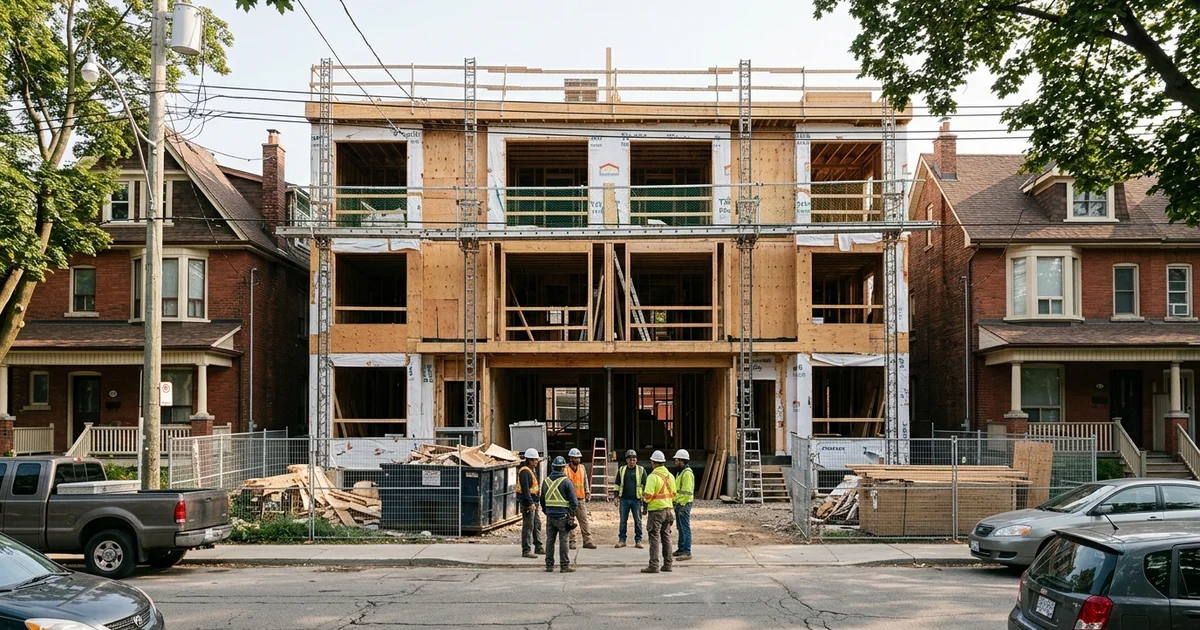
We see the rush to build now that Ontario zoning rules have opened up the map. The financial stakes are massive when you are trusting someone with a $500K to $2M project, a construction loan, and a building that has to pass code for several separate homes.
Our team knows that the best time to protect yourself is before any deposit changes hands. This guide gives you a checklist for hiring a multiplex builder in Ontario that works whether you hire us or someone else.
We lay out exactly how we handle each item on this list over on our multiplex construction process page.
The one-minute check
Search the builder in the HCRA Ontario Builder Directory. Confirm the legal name matches the contract. Ask for Tarion enrolment confirmation for your project before construction. If any of those three fail, stop.
Licensing and Warranty: HCRA and Tarion
Ontario requires every builder constructing a new multiplex to hold an active HCRA licence and enrol the project with Tarion. This dual-layer system protects your deposit and guarantees the structural integrity of the finished building.
HCRA Registration
The Home Construction Regulatory Authority (HCRA) licenses new home builders and vendors in Ontario. Anyone building a new home, which includes new multiplex units, must be registered. Use the hcra builder lookup tool in the Ontario Builder Directory and check:
- The exact legal entity name, which must match your contract
- That the registration is current, with no lapse
- Any conditions on the licence
- Any past enforcement history listed
Our advice is to check the directory right before signing, because enforcement is accelerating. A major crackdown by the HCRA recently resulted in fines up to $500,000 for corporations caught building illegally in Ontario.
A common problem is a contract signed with one company name while the registration sits under another. Another risk is a registration that lapses mid-project. Either scenario leaves your deposit exposed and your lender angry.
Tarion Enrolment Per Project
Tarion administers Ontario’s new home warranty program. The registered builder must enrol each new home with Tarion before construction starts. Coverage follows the statutory 1-2-7 year structure. You get one year for workmanship and materials, two years for items like water penetration, and seven years for major structural defects.
We highly recommend familiarizing yourself with the updated 2026 Tarion limits. The maximum statutory warranty coverage available for freehold homes sits at $400,000. New rules also require freehold buyers to notify Tarion within 45 days of signing to secure maximum deposit protection, which covers up to $100,000. Confirm your tarion multiplex enrolment is completed before construction starts.
Insurance and Safety
Ask for current certificates from the builder to prove they carry adequate liability and safety coverage. Generic promises of being fully covered are not enough to protect your property from massive financial risk.
Ask for current certificates, not just a verbal yes:
- WSIB clearance certificate, so you are not liable for workplace injuries on your site
- Commercial general liability (CGL) insurance, ideally $5M, naming the correct entity
- Proof of builder’s risk coverage, or clarity on who carries it
We always provide WSIB clearance certificates because they expire every 90 days, meaning a printed copy from last year is useless. You must verify the dates are current for your specific project timeline.
Builder’s risk insurance, also called Course of Construction coverage, is another critical document. This specialized policy protects the structure during the build phase and typically costs 1% to 2% of the total project value. Someone must carry this policy, and your contract must clearly state if that cost falls to you or the builder.
Specialist, General Contractor or Design-Build?
Hiring a multiplex specialist ensures you capture critical multi-unit zoning details that a standard general contractor might miss. A specialist understands the specific building code requirements for fire separations and separate utility metering.
| Factor | Multiplex specialist | General contractor | Design-build firm |
|---|---|---|---|
| Zoning verification before deposit | Usually standard | Often skipped | Varies |
| EHON and sixplex zone knowledge | Core skill | Often limited | Varies |
| CoA variance filing and representation | Often in-house | Usually outsourced | Varies |
| Multi-unit MEP and separate metering | Core skill | Sometimes missed | Varies |
| Fixed price after feasibility | Common | Often cost-plus | Common |
We track Toronto development charges closely, and a specialist will know that recent bylaws exempt multiplexes up to six units from these fees. A general contractor might mistakenly add $80,000 per unit in estimated development charges to your budget, ruining the financial viability of your project.
A general contractor may build beautiful houses and still miss the multi-unit details like separate meters, egress for every bedroom, and the zoning traps around unit count. A specialist does this every week. Our guide on the fixed-price design-build contract explains what a well-written contract should contain. For realistic budget numbers before you sign, see our guide on how much it costs to build a multiplex in Ontario.
Contract Red Flags
A bad contract shifts all the financial risk onto the property owner. You must review the document for vague allowances and missing milestones before signing anything.
Watch for these before you sign:
- Open-ended cost-plus with no cap or guaranteed maximum
- No named licensed entity, or a name that does not match the HCRA directory
- A unit count with no written zoning verification, especially a sixplex outside the Toronto and East York District or Scarborough Ward 23 North
- Large deposits before permits, beyond what feasibility and design reasonably cost
- Vague allowances for fixtures and finishes with no dollar amounts
- No draw schedule, or one that does not match your lender’s milestones
- No written warranty terms beyond “industry standard”
- Severance language in a multiplex contract, which suggests the builder is confusing two different processes
Our team flags these common multiplex contractor red flags as the biggest danger in the current market. Construction loan interest rates are too high to tolerate a project that goes 30% over budget because the builder failed to guarantee a maximum price.
The Mid-Project HCRA Lapse
A lapsed HCRA registration mid-project will bring your construction site to an immediate halt. Your lender will freeze funds, and your warranty coverage will become uncertain.
One scenario we see often involves an owner who signs, pays a deposit, and starts building. Halfway through framing, they learn the builder’s HCRA registration has lapsed or the Tarion enrolment was never completed. The owner then has to scramble for a new builder mid-project, which can cost tens of thousands of dollars in delays.
The fix is simple and happens before signing. Check the directory, match the entity name, and ask for Tarion confirmation before mobilization. We put the licensed entity’s legal name in every agreement and share registration details before any deposit.
How to Compare Two or Three Quotes
Comparing multiplex quotes requires lining up the specific line items to ensure both builders are pricing the exact same building. Two different totals often describe two completely different scopes of work.
Before comparing totals, line the quotes up on the same items.
| Check | Quote A | Quote B | What to look for |
|---|---|---|---|
| Unit count and zoning basis | Written zoning confirmation for the parcel | ||
| Part 9 or Part 3 | Sprinklers and second exit priced if Part 3 | ||
| Fire and sound separations | Ratings and assemblies named | ||
| Utility upgrades | Hydro service and water lateral included or excluded | ||
| Allowances | Realistic dollar amounts for fixtures and finishes | ||
| Exclusions | Land, financing, development charges listed | ||
| Variances | Who files, and is time allowed for it | ||
| Warranty | Written workmanship warranty and Tarion enrolment | ||
| Payment schedule | Matches your lender’s draw milestones |
We advise clients to look closely at the Part 9 versus Part 3 building code line item. A cheaper quote might assume a standard fourplex under Part 9, while a correct quote for a sixplex includes Part 3 requirements like an NFPA 13R sprinkler system. Adding fire sprinklers typically costs $3,000 to $6,000 per unit, plus the cost of upgrading to a 2-inch water service lateral.
Fill in the middle columns yourself. A quote that is much cheaper usually differs in one of these rows. You might find a lower unit count assumption, missing utility upgrades, thin allowances, or no Part 3 costs on a sixplex.
Ask for References the Right Way
Reference checks must go beyond simple testimonials to uncover how the builder handles delays and budget overages. A past client’s experience with a mid-project problem tells you everything you need to know.
Do not just ask for testimonials. Ask to speak with an owner whose multiplex finished in the last two years, ideally one with a variance or a conversion, because those projects test a builder most. Ask that owner three specific questions. Did the price hold, did the schedule hold, and how were problems handled when they came up?
Our process involves letting you speak with past clients about change orders. A true professional will limit change orders to structural surprises or client upgrades, keeping the core margin predictable.
Watch the Communication Before You Sign
Early communication habits are a highly accurate preview of how the builder will manage the actual construction site. A contractor who is vague before signing rarely becomes precise once they have your money.
How a builder communicates during the quote stage is a good preview of the project. Are your questions answered in writing? Are assumptions stated clearly? Do they tell you when something is uncertain?
We look for builders who use dedicated construction management software like Procore or BuilderTrend during the quoting phase. A professional estimate built in proper software proves they are measuring materials accurately, rather than just guessing a price per square foot.
Questions to Ask Before Paying a Deposit
You must ask pointed questions about licensing, warranties, and zoning before writing a cheque for your project. A qualified multiplex builder will answer these questions in writing without hesitation.
- What is your HCRA registration and the exact legal entity on my contract?
- When will my project be enrolled with Tarion?
- Can I see your WSIB clearance and $5M CGL certificate?
- How did you confirm my lot can carry this many units?
- Is this design Part 9 or Part 3, and how did you decide?
- Will I need a Committee of Adjustment variance? Who files it?
- Is the price fixed? What are the allowances and exclusions?
- Who is my single point of contact from start to finish?
- Can I speak to an owner of a finished multiplex you built?
Our experience shows that owners in Etobicoke are often the ones who need this list most. Sixplex pitches outside the approved zones are common there, and our Etobicoke multiplex construction page covers the local issues in detail.
If you want to run through these questions with someone who will answer every one in writing, talk to a multiplex specialist on our team.