

The Question Behind the Question
Is a fourplex a good investment in Toronto? It can be, but the answer lives in your numbers, not in general market talk. A fourplex turns one lot into four rent streams and a building appraised on income. It also ties up equity, carries a construction loan for a year or more and makes you a landlord. This guide gives you a framework to test it yourself before you pay for anything.
When the math works and you decide to build a fourplex, the feasibility report turns these estimates into numbers for your lot.
We do not publish rents
Rents move month to month and block to block. Use current listings for comparable units near your lot. Everything else in this guide uses our published cost bands and your own assumptions.
Step 1: Total Project Cost
Start with everything it takes to get to occupancy:
- Construction: a fourplex typically costs $500K-$1.4M CAD, or about $320-$520 per sqft
- Soft costs: feasibility ($1,500-$4,500), design ($15K-$60K), permits ($5K-$18K), city fees, surveys and reports
- Demolition and site work if not already in the construction price
- Financing costs: construction loan interest and fees during the build
- Land: if you own the lot already, use its current value as your opportunity cost
Step 2: Gross Rent
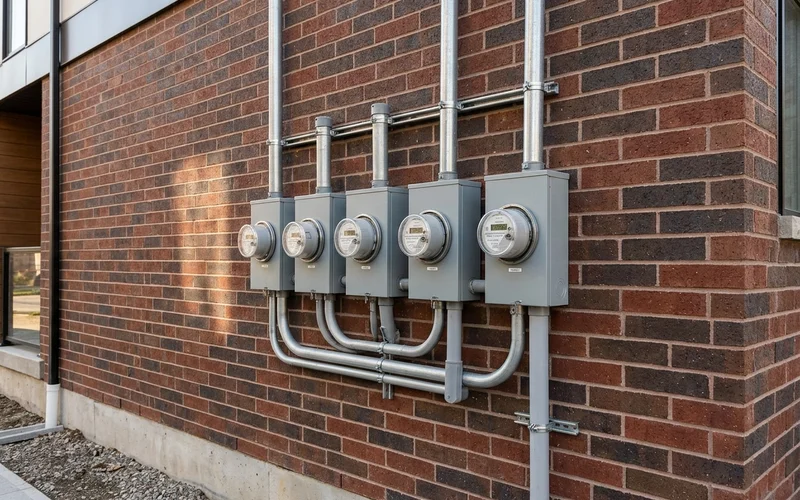
Take your realistic monthly rent per unit, multiply by four, then by 12. Size matters: a 900 sqft two-bedroom rents for more than a 550 sqft one-bedroom squeezed onto a narrow lot. Separate meters matter too, because tenants paying their own hydro changes both rent expectations and your costs. Unit size depends heavily on layout, which our guide on stacked vs side-by-side fourplex layouts compares.
Step 3: Net Operating Income
Deduct:
- Vacancy allowance: a few percent is common for planning
- Operating costs: property tax, insurance, maintenance, common-area utilities, and management if you hire it. For planning, many owners use a percentage of rent
The result is your net operating income for the year.
Step 4: Yield and Payback
Divide net operating income by total project cost for a simple yield. Divide total cost by net income for a simple payback in years. These are rough tools, not investment advice, but they tell you quickly whether a project is worth a closer look.
| Input | Where it comes from |
|---|---|
| Construction cost | Our published bands, then a fixed price after feasibility |
| Soft costs | Feasibility report estimate |
| Rent per unit | Your research on current local listings |
| Vacancy and operating costs | Your assumptions or your property manager |
| Financing carry | Your lender’s terms, see how multiplex financing works |
Our rental income calculator on the tools page runs this math for you with your own inputs.
Step 5: Completed Value
A finished fourplex is often valued on its income. If net income is strong relative to cost, the completed value can exceed what you put in, which matters for refinancing. If the unit count is wrong, for example a fourth unit that turns out to be illegal, both income and value fall.
The Leslieville Reference Project
Our Leslieville fourplex project is a useful benchmark. On a standard 25x120 lot, the build came in at $1.08M, including a Committee of Adjustment side-yard variance. It took 11 months from feasibility to occupancy, and delivered four self-contained two-bedroom units with separate hydro meters and an HRV per unit. Plug in current two-bedroom rents for that area and you can see how the yield looks for a similar project.
What Makes a Fourplex Pencil Out
From the projects we have built, these factors matter most:
- The right unit count for the lot. Four good units beat four cramped ones, and sometimes three good units beat both.
- No surprise variances. Each one adds 4-6 months of carrying cost.
- A fixed construction price. Cost overruns hurt yield more than almost anything else.
- Separate utilities. Lower operating costs and fewer disputes.
- Energy performance. Toronto Green Standard Tier 1 lowers running costs for you or your tenants.
- Unit size matched to the market. Two-bedroom units often hit the widest tenant pool.
When a Fourplex Is Not the Right Move
- You need the cash within two or three years
- Your lot only fits four units with several variances
- You cannot carry the gap between construction draws
- You do not want to be a landlord and have not budgeted for management
In those cases, a triplex, a conversion of the existing house, or simply selling the lot may be the better answer. The feasibility report compares options honestly.
A Worked Example With Placeholder Numbers
Here is the framework run with simple, illustrative inputs so you can see how the pieces fit. Replace every number with your own before relying on it.
| Input | Illustrative value |
|---|---|
| Construction cost | $1,100,000 |
| Soft costs (design, permits, fees) | $90,000 |
| Monthly rent per unit (your research) | R |
| Units | 4 |
| Vacancy allowance | 3% |
| Operating costs (% of rent) | 25% |
Gross annual rent is 4 x R x 12, or 48R. After a 3% vacancy allowance, you have about 46.6R. After operating costs of 25%, net operating income is roughly 34.9R. Total project cost is $1,190,000 before financing. Your simple yield is 34.9R divided by $1,190,000.
That last line is the useful one. It tells you what monthly rent per unit you need to reach the yield you want. If you want a 6% simple yield on cost, you need 34.9R to equal about $71,400, which means R of roughly $2,045 per unit per month in this example. If your local listings support well above that, the project has room. If they do not, the project is thin.
Stress-Test the Result
- Raise construction cost by 5% and see if the yield still works.
- Add three months of carrying cost for a possible variance.
- Increase vacancy to 5% for the first year.
- Use rents from the lower end of comparable listings.
If the project still works under those tests, it is worth a feasibility report. If it only works on the best-case numbers, the lot may suit a triplex, a conversion or simply a sale.
Next Step
Test your assumptions in the calculator, then run the numbers on your lot with a written feasibility assessment. You will get the unit count your zoning allows, a CAD budget range, and a clear basis for your own rent and yield math.