

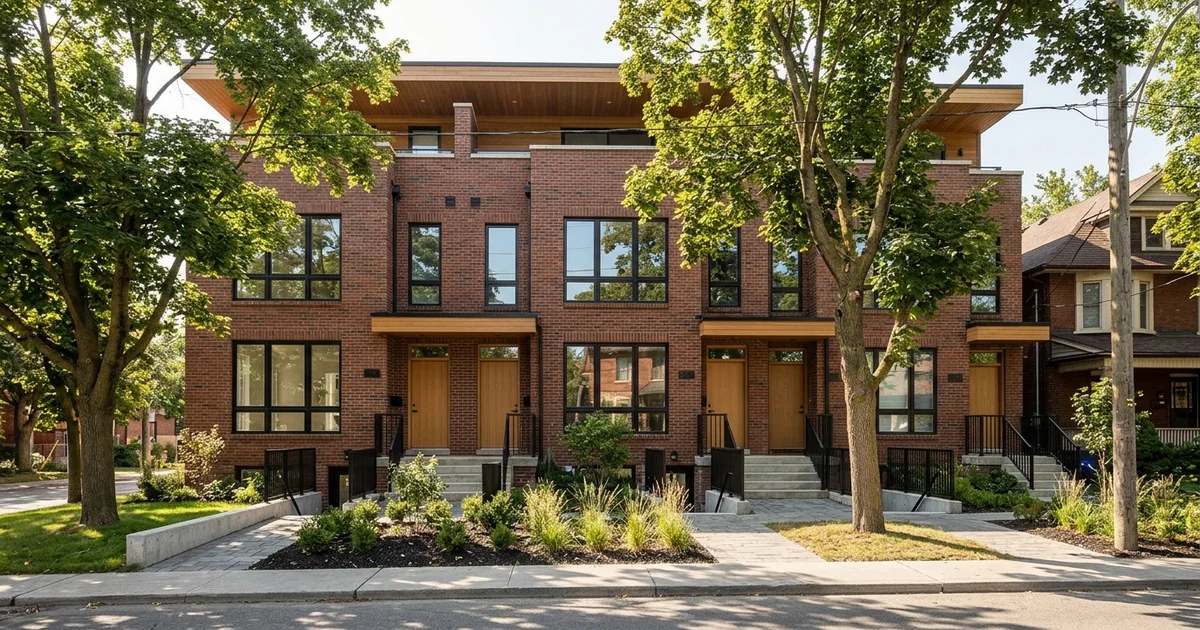
What EHON Means for Toronto Lot Owners
EHON stands for Expanding Housing Options in Neighbourhoods. It is the City of Toronto program that changed Zoning By-law 569-2013 so that residential lots across the city can hold more homes without a rezoning. If you own a house in Toronto, EHON is the reason your lot may now be able to carry three, four, and in two areas, six units. Understanding Toronto EHON multiplex rules is the first step before you talk to any builder.
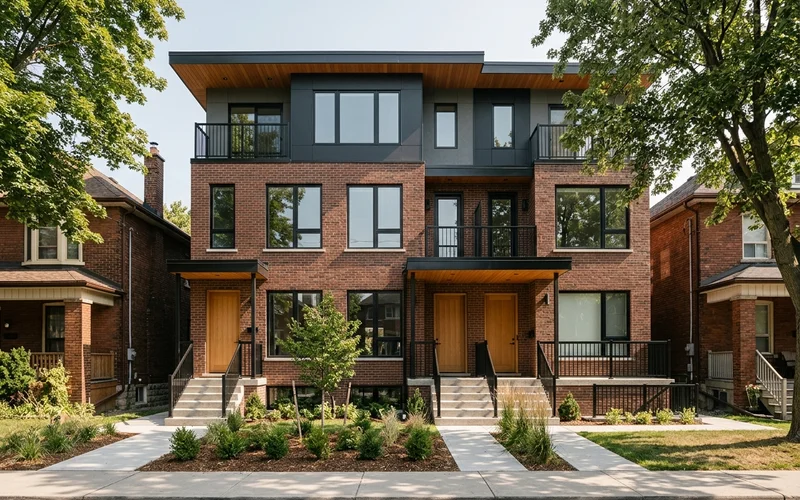
In 2023, Toronto City Council approved multiplexes citywide. That made up to four units as-of-right on lots in residential zones across the whole city, not just in a few pilot areas. As-of-right means you do not need to apply for a rezoning to build that many units. You still need a building permit, and the building still has to meet the zoning rules for setbacks, height and coverage. If you are planning a new build, our multiplex construction service is where we turn that permission into an actual building.
Permission is not the same as fit
EHON tells you how many units are allowed. Your lot’s setbacks, height limit, lot coverage and soft landscaping rules decide how many units actually fit. On many 25-foot lots, the answer is two or three good units without a variance, not four.
The 2025 Sixplex Amendment
In 2025, the city went further and allowed up to six units on residential lots, but only in two parts of Toronto:
- The Toronto and East York District, which covers the old City of Toronto and East York, including areas like Riverdale, Leslieville, the Annex, Leaside and Woodbine Heights
- Scarborough Ward 23 North, around Milliken and the northern edge of Scarborough
Everywhere else in the city, including North York, Etobicoke, York and the rest of Scarborough, four units remains the as-of-right maximum. This is where many owners get misled. A sixplex pitch on an Etobicoke lot is not a creative idea, it is a project that cannot get a permit as drawn. Our guide on where sixplexes are allowed walks through the boundaries in more detail.
Six units also changes the building itself. Most sixplexes exceed the Ontario Building Code Part 9 limits of 600 square metres or three storeys and move into Part 3, which brings sprinklers, a second exit and an OAA architect. The extra units can pay for that, but only where they are allowed.
What EHON Does Not Change
EHON raises the number of units you can have. It does not remove the other rules in By-law 569-2013. Here is how the main pieces fit together:
| Rule | What EHON changed | What still applies |
|---|---|---|
| Unit count | Up to 4 citywide, up to 6 in two approved areas | Units must still fit the building envelope |
| Building permit | No rezoning needed for the unit count | Full permit review and inspections |
| Setbacks | Generally unchanged | Front, rear and side yard limits |
| Height | Some adjustments for multiplexes | Zone height limits still cap the building |
| Lot coverage and landscaping | Some adjustments | Soft landscaping share of the rear yard |
| Parking | Reduced in many cases | Some lots still need parking or a variance |
| Heritage and trees | No change | HPS review, Urban Forestry tree protection |
The practical result is that two lots on the same street can have very different answers. A 40-foot lot with a lane behind it may fit four units easily. A 25-foot lot next door may fit three without a variance, or four only with a side-yard variance that adds 4-6 months at the Committee of Adjustment. To see which unit count fits your lot and budget, read our comparison of triplex vs fourplex vs sixplex.
EHON Outside Toronto
EHON applies only within the City of Toronto. If you own in Vaughan, Markham, Richmond Hill, Mississauga, Brampton or Pickering, the rules are set by your own city. Each has its own additional residential unit or secondary suite framework, often allowing a main unit plus one or two additional units, with different parking, entrance and size rules. Mississauga, for example, works under Zoning By-law 0225-2007, and Markham and Brampton run their own additional residential unit by-laws.
That does not mean multiplex-style projects are impossible outside Toronto. It means the unit count, layout and approval path are different. A builder who quotes Toronto EHON rules for a Vaughan or Brampton lot is a builder who has not checked.
How EHON Affects Real Projects
Here is how EHON plays out on lots we see every week:
- Leaside, 40-foot lot: Inside the Toronto and East York District. Four units fit comfortably. Six may be possible as a Part 3 building if the numbers justify sprinklers and a second exit.
- Danforth Village, 25-foot lot: Inside the district, but narrow. Three units fit without a variance. Four may need a side-yard variance.
- Willowdale, 50-foot lot: North York, so four is the maximum. The wide lot often fits four without any variance.
- Mimico, 35-foot lot near the lake: Etobicoke, so four is the maximum. Lakeshore exposure means 316 stainless fasteners in the build.
Owners in older Toronto neighbourhoods, like the wartime and post-war streets we work on for multiplex builds in East York, often find a mix of good news and constraints: sixplex permission on paper, but narrow lots, ravine edges and heritage overlays that shape what actually fits.
Common EHON Misunderstandings
A few beliefs come up in almost every first conversation we have with owners. Each one sounds reasonable, and each one can cost real money if you act on it.
“As-of-right means no approvals.” As-of-right removes the need for a rezoning to reach the permitted unit count. You still need a building permit, a zoning compliance review, inspections at every stage and, if the design breaks a setback or height rule, a minor variance from the Committee of Adjustment.
“Four units on every lot.” Four units are permitted on residential lots, but the building still has to fit the envelope. A 25-foot lot often fits three good units without a variance. A 50-foot North York lot can fit four comfortably. Same rule, very different outcomes.
“Sixplexes are allowed now.” Only in the Toronto and East York District and Scarborough Ward 23 North. A sixplex pitched in Etobicoke, North York or York is a project that cannot be permitted as drawn.
“EHON means I can sever.” EHON keeps every unit on one lot under one title. Splitting the land into separate parcels is a consent application under a different process.
“The GTA has the same rules.” It does not. Vaughan, Markham, Richmond Hill, Mississauga, Brampton and Pickering each set their own additional unit rules.
| Belief | Reality |
|---|---|
| No approvals needed | Building permit and inspections always apply |
| Four units fit anywhere | The envelope decides; narrow lots often fit three |
| Sixplex citywide | Two approved areas only |
| EHON allows severance | Units stay on one lot and one title |
| GTA follows EHON | Each city has its own rules |
The pattern behind all five is the same: EHON changed what is allowed, not what fits or how it gets approved. That is why we treat the zoning check as the first step on every project, before any drawing or deposit.
How to Check Your Own Lot
You can do a rough self-check before calling anyone:
- Confirm your address is in the City of Toronto, not a neighbouring city.
- Find your district. Is the lot in the Toronto and East York District or Scarborough Ward 23 North?
- Measure your lot frontage and depth from your survey or listing.
- Check whether the house is on the Toronto Heritage Register.
- Look for large trees, ravines or a lane at the back.
That gets you a first impression. To rely on it for a purchase, a loan or a design contract, you need the parcel’s zoning confirmed and the setback math done for your exact lot. That is what a written feasibility report covers: a GeoWarehouse zoning pull, a unit-count test, a heritage, tree and servicing screen and a CAD budget range.
If you want that answer for your address, you can get a written feasibility assessment in 1-2 weeks. It is the cheapest step in any multiplex project, and the one that keeps you from paying for drawings your lot can never carry.